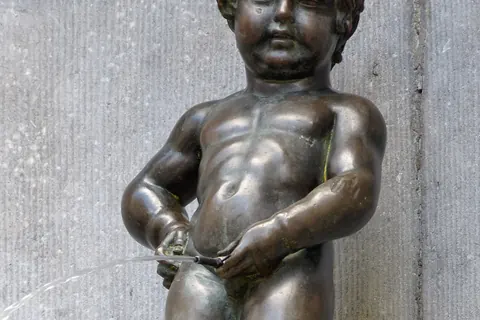
Manneken Pis is a landmark 55.5 cm bronze fountain sculpture in central Brussels, Belgium, depicting a puer mingens: a nude boy urinating into the fountain’s basin. Though its existence is attested as early as the mid-15th century, Manneken Pis was redesigned by the Brabantine sculptor Jérôme Duquesnoy the Elder and put in place in 1619. Its blue stone niche in rocaille style dates from 1770. The statue has been repeatedly stolen or damaged throughout its history. Since 1965, a replica has been displayed on site, with the original stored in the Brussels City Museum.
Manneken Pis is one of the best-known symbols of Brussels and Belgium, inspiring several legends, as well as numerous imitations and similar statues, both nationally and abroad. The figure is regularly dressed up and its wardrobe consists of around one thousand different costumes. Since 2017, they have been exhibited in a dedicated museum called GardeRobe MannekenPis, located on the same street. Owing to its self-derisive nature, Manneken Pis is also an example of belgitude, as well as of folk humour popular in Brussels.
Manneken Pis is approximately five minutes’ walk from the Grand-Place/Grote Markt, at the junction of the Rue du Chêne/Eikstraat and the pedestrian Rue de l’Étuve/Stoofstraat.
Sources
Text: introduction of the Wikipedia article Manneken Pis, under the CC BY-SA 4.0 licence (authors: article history). Facts: Wikidata (CC0). Coordinates: Wikidata, map background © OpenStreetMap contributors.