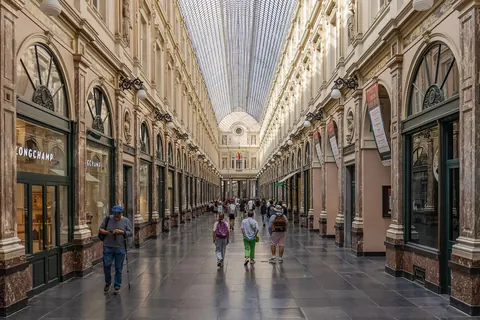
The Royal Saint-Hubert Galleries is an ensemble of three glazed shopping arcades in central Brussels, Belgium. It consists of the King’s Gallery, the Queen’s Gallery and the Princes’ Gallery.
The galleries were designed and built by the architect Jean-Pierre Cluysenaar between 1846 and 1847, and precede other famous 19th-century European shopping arcades, such as the Galleria Vittorio Emanuele II in Milan and the Passage in Saint Petersburg. Like them, they have twin, regular façades with distant origins in Vasari’s long, narrow, street-like courtyard of the Uffizi in Florence. They feature glazed, arched shopfronts separated by pilasters and two upper floors, all in an Italianate style inspired by the Cinquecento, under an arched, glass-paned roof with a delicate cast-iron framework. The complex was designated a historic monument in 1986.
The galleries are located near the Grand-Place/Grote Markt, in the block between the Rue du Marché aux Herbes/Grasmarkt and the Rue de la Montagne/Bergstraat to the south and east, the Rue d’Arenberg/Arenbergstraat and the Rue de l’Ecuyer/Schildknaapsstraat to the north, and the Rue des Dominicains/Predikherenstraat and the Rue des Bouchers/Beenhouwersstraat to the west.
Sources
- Wikipédia (fr) : Galeries royales Saint-Hubert
- Wikipedia (en): Royal Saint-Hubert Galleries
- Wikidata: Q1491935
- Official website
Text: introduction of the Wikipedia article Royal Saint-Hubert Galleries, under the CC BY-SA 4.0 licence (authors: article history). Facts: Wikidata (CC0). Coordinates: Wikidata, map background © OpenStreetMap contributors.